





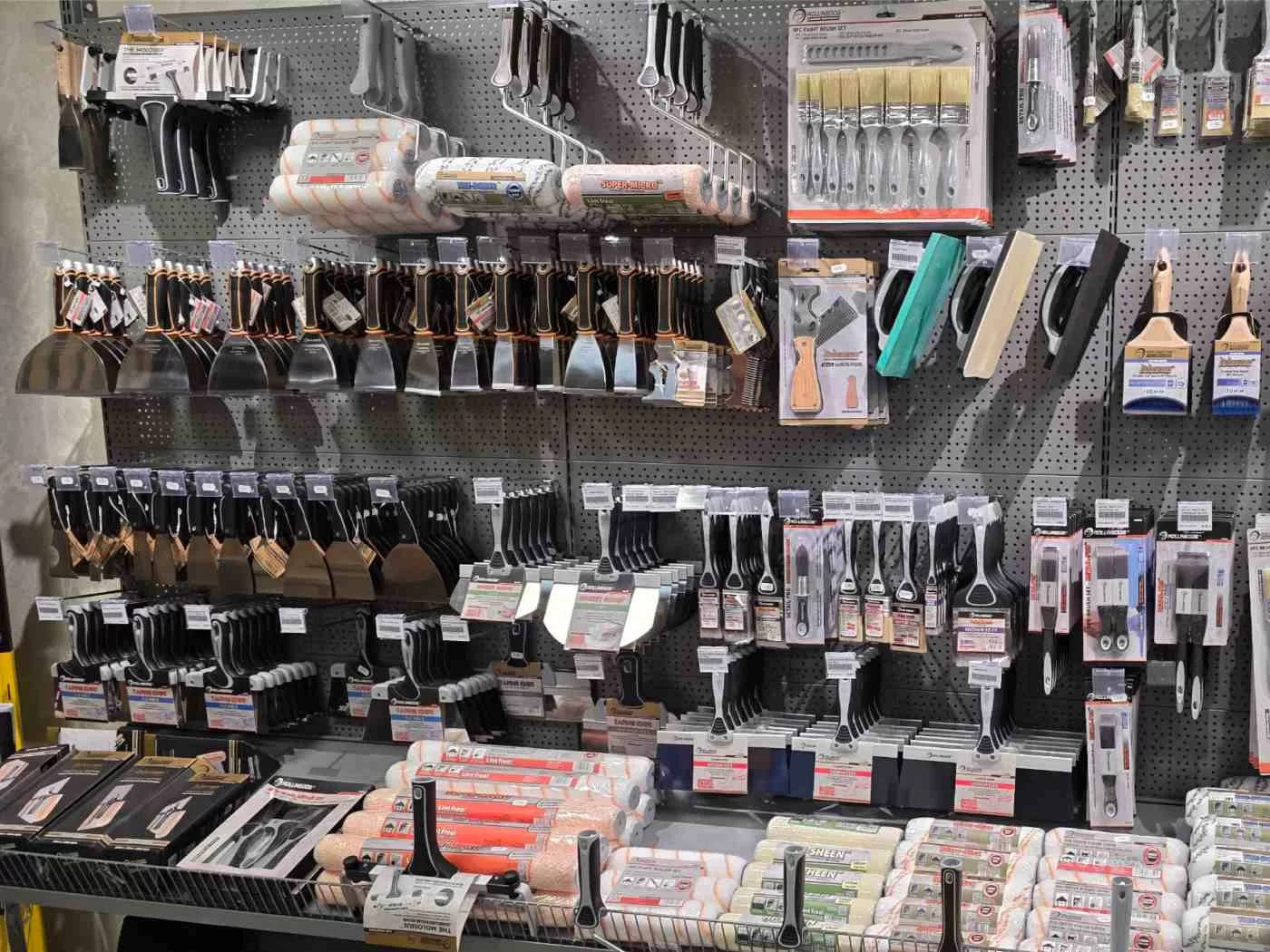
Professional paint sundries grew 7.9% to $3.525 billion in 2025, while consumer and DIY demand contracted by 4%, according to the Home Improvement Research Institute (HIRI, 2026). For retail chains managing a paint tools category, that divergence points to an assortment problem most buyers haven’t resolved: the shelf is still built for the DIY customer, but the growth is in the professional segment. Three structural shifts now determine category margin in 2026: where volume lives, how SKU lists are tightening, and which supplier credentials are filtering the RFQ.
Key Takeaways
Why Is the Professional Segment Growing Faster Than the Consumer Market?
The professional contractor segment accounts for 46% of the global painting tool end-user market, according to Global Market Insights (January 2026). Professional paint sundries grew 7.9% in 2025 while consumer demand contracted. Construction project pipelines drive professional renovation work; consumer DIY tracks disposable income — and that’s under pressure.
Most paint tools sections are still weighted toward entry-level and mid-tier DIY products. Contractors looking for professional-grade tools — 9″ and 18″ frames with five-wire cage construction, microfiber covers in the nap thicknesses they actually use, extension poles with reliable twist-lock engagement — frequently don’t find them. They default to trade suppliers instead.
Planogram positioning matters. Professional SKUs at eye level in a dedicated section, clearly separated from value-tier products, signal to contractors that the store stocks what they need. Chains that reorganized their paint tools into an explicit DIY/PRO split report higher average transaction values from the professional segment without changing the actual product range. The complete guide to essential paint tools for hardware stores in 2026 covers which specific SKUs to prioritize at each tier.
Observed across ROLLINGDOG’s retail distribution accounts: Contractors evaluate extension pole thread engagement and roller frame wire count within 30 seconds of handling a product. A pro section that doesn’t pass both tests loses the sale. Portfolio coherence at the professional tier matters as much as individual product quality.
What Product Specs Define a Credible Professional Range?
Professional painters evaluate tools on technical criteria that differ from DIY purchases. Frame rigidity and wire count matter because high-volume use exposes failures that weekend use doesn’t reveal. Nap specification needs to match dominant surface types: 3/8″ for smooth drywall, 1/2″ for standard textured walls, 3/4″ for heavily textured surfaces. Extension pole systems need reliable thread engagement for overhead work at height. A range that covers these specs at a professional-grade quality level, stocked at a dedicated shelf position, is the floor. Without it, contractor spend goes to trade suppliers. The full range of paint roller specifications for professional assortments covers frame, cover, and pole combinations relevant to each surface application.
The contractor segment is 46% of the global painting tool market by end-user share (Global Market Insights, January 2026), but most retail shelves are still weighted toward DIY. Professional paint sundries grew 7.9% to $3.525 billion in 2025 while consumer demand fell 4% (HIRI, March 2026). Chains that haven’t reorganized toward the professional segment are giving up that growth to trade distributors.
How Is E-Commerce Restructuring the Paint Tools Shelf?
E-commerce accounts for 18% of global paint tools sales in 2025 and is forecast to reach 28% by 2035, according to IndexBox (2026). That shift is gradual — 1 percentage point per year — but it matters for retail chains that haven’t thought carefully about which SKUs to defend on the physical shelf and which to let migrate online. The category is moving to platforms they don’t control, and the shift isn’t uniform across the assortment.
The shift runs faster at the commodity end. Standard frames, entry-level covers, and basic brushes are migrating online faster than professional-grade tools. Tactile evaluation still drives professional purchases: contractors check thread engagement on extension poles, test frame rigidity, and compare nap depth on roller covers before they commit. That evaluation behavior keeps professional tools on physical shelves. The digital pressure falls hardest on the SKUs with the thinnest margins, which is the problem for a section still weighted toward value-tier commodity products.
The practical implication for category managers: the physical shelf should contract at the value end and expand at the professional end. Chains that continue allocating space to duplicative value-tier SKUs are competing against Amazon in the segment Amazon is best positioned to win — on price, convenience, and selection depth. The professional range is where physical retail has a real advantage.
Real-world data from Kingfisher’s FY 2024/25 audited results (March 2025) shows how this plays out. B&Q’s e-commerce penetration reached 15% in the fiscal year — up from 13% — with online sales rising 17.2% year over year. More telling for paint tools buyers: B&Q’s TradePoint platform, which serves professional contractors and trade buyers, now represents 23.4% of total B&Q sales, up 6.4% in the same period. Physical retail serving professional buyers is a growth channel. Physical retail competing on commodity SKUs is losing ground.
E-commerce was 18% of global paint tools sales in 2025 and is forecast to reach 28% by 2035 (IndexBox, 2026). At B&Q, online sales grew 17.2% year over year in FY 2024/25 while TradePoint, the contractor-facing channel, grew 6.4% and now accounts for nearly a quarter of total B&Q revenue (Kingfisher plc, March 2025). The pattern is consistent: commodity tools migrate online; the professional range holds in physical retail.
What Does SKU Rationalization Mean for Paint Tool Suppliers?
Lowe’s cut 15% of its total in-store SKU count as part of an active range simplification program, and that move generated a 50 basis point gross margin improvement in Q3 2025 (Retail Dive, 2025). Fewer SKUs with better velocity and clearer tier differentiation outperform a broader assortment where multiple products compete for the same customer at similar price points with no meaningful difference between them.
The cuts don’t fall randomly. SKUs that survive range reviews tend to share three characteristics: consistent velocity data, clear tier differentiation, and supplier reliability that reduces vendor management overhead. In paint tools, this typically favors manufacturers who can deliver a complete three-tier portfolio — value, professional core, and premium — from a single relationship. Buyers managing five vendors to cover the same three price points are the first to consolidate.
48% of independent hardware retailers are prioritizing investment in paint and sundries in 2026 — more than any other product category, ahead of lawn and garden (43%) and hardware and fasteners (38%), according to the NHPA 2026 Market Measure Report (Hardware Retailing, January 2026). Category managers are actively investing. But the investment favors suppliers with clear range logic, not those with the deepest discount.
Observed across ROLLINGDOG’s retail distribution: Category managers who consolidate paint tool vendors from four-plus to two typically retain the supplier with the clearest tier separation — value, professional, premium — rather than the lowest unit price. Portfolio clarity is the deciding factor more often than cost alone.
Bundled kits take this further. Professional painting tool sets — roller frame, cover, tray, and brush in one package — improve transaction value, increase inventory turns, and simplify the purchase decision for the customer. Chains that moved toward bundle-anchored planograms in paint tools report simpler replenishment and fewer SKU duplication problems at the value tier.
How Many SKUs Should a Retail Paint Tools Section Carry?
The most efficient paint tools sections operate with 40–80 active SKUs across three clear tiers. Sections above 120 SKUs typically carry value-tier duplication that reduces inventory turns without adding meaningful category breadth. The duplication usually concentrates in commodity frames and entry-level covers — the products where brand differentiation is lowest and where online channels have a persistent price advantage. Cutting the long tail at the value end, while deepening the professional range, is what most large-format chains are actively doing.
Forty-eight percent of independent hardware retailers prioritize investment in paint and sundries in 2026, more than any other product category (NHPA 2026 Market Measure Report, Hardware Retailing, January 2026). At Lowe’s, cutting 15% of in-store SKUs generated a 50 basis point gross margin improvement in Q3 2025 (Retail Dive, 2025). As range reviews continue, suppliers who cover three clear portfolio tiers from a single relationship are better positioned to stay on the shortlist.
Why Are Microfiber Roller Covers Carrying the Category’s Margin Growth?
The global paint rollers market is valued at $4.15 billion in 2026 and projected to reach $7.64 billion by 2036 at a 6.3% CAGR, according to Future Market Insights (April 2026). Within that growth, the microfiber and blended-fiber segment is expanding faster than the market average. Professional painters who prioritize coverage consistency and a lint-free finish over price per unit are driving that segment.
Microfiber covers hold more paint per load than equivalent polyester covers and release it more evenly on textured surfaces. For a contractor buying by the case, this means fewer reloads per wall section, more even coverage on each pass, and fewer coats on a standard job. A meaningful price premium over standard polyester is rational for a production painter when it reduces labor hours on a commercial project.
For retail chains, this shows up as margin per linear foot of shelf. Microfiber covers sell at higher rates to professional customers and generate more revenue per unit than standard polyester alternatives at the same shelf position. A section weighted toward microfiber and blended-fiber options captures more of the professional transaction value than one anchored on entry-level polyester in each nap size. Browse the full range of professional roller specifications to see how different cover materials map to application requirements.
Nap specification is where most retail assortments leave margin. Stocking 3/8″ microfiber for smooth drywall and 3/4″ polyester-blend for textured surfaces covers the two highest-volume residential applications without requiring a complex SKU count. Roller covers also reorder 3–5× faster than roller frames in most retail accounts. An assortment that underweights covers relative to frames gives up that reorder velocity. The nap thickness selection guide covers the full specification range, and the roller specification guide covers how cover selection affects assortment planning.
The paint rollers market is growing at 6.3% CAGR through 2036, above the 4.4% average for the broader painting tools category (Future Market Insights, April 2026). Within that, the microfiber segment is expanding faster than the market average, pulled by professional contractors who buy on coverage consistency rather than unit price. For retail chains, the highest-velocity SKU category in the section is roller covers — specifically microfiber SKUs weighted toward the two nap sizes that cover the highest-volume residential applications.
Are Sustainability Certifications Now a Baseline Procurement Requirement?
FSC and GRS certifications are now baseline requirements at major retail chains, not optional differentiators. The shift is fastest in European markets, where publicly listed DIY retailers face ESG reporting obligations tied to sustainable sourcing policies, but it’s accelerating in North America as well. Failure to hold these certifications now disqualifies suppliers at chains with published sourcing policies — most large-format DIY retailers in Western Europe.
The four certifications that appear most frequently in European retail chain RFQ documentation address different parts of the supply chain: ISO 9001 for quality management, BSCI for social compliance across manufacturing, FSC for sustainable wood sourcing in handles and components, GRS (Global Recycled Standard) for synthetic fiber from recycled materials. Major buyers increasingly expect all four.
Most Asian manufacturers don’t hold FSC or GRS certification — either because their domestic customers don’t require it or because of the initial audit cost. For retail chains that need certification documentation to satisfy annual ESG disclosure requirements, supplier certification status has become a practical filter in the RFQ process, not a differentiated selling point for the manufacturer who holds them.
The sustainability shift in applicator tools tracks the broader change in coatings. Waterborne coatings — lower VOC, lower environmental impact — accounted for 40.8% of the global paints and coatings market in 2024 (Straits Research, 2025). Buyers who have already switched to low-VOC waterborne paint are applying the same sourcing criteria to the tools. Certification documentation is available through the ROLLINGDOG quality standards page, and certification reference sheets are included in the product catalogue download.
FSC and GRS certifications are now baseline procurement criteria at European retail chains with published ESG sourcing policies, not differentiators. Waterborne coatings reached 40.8% of the global paints and coatings market in 2024 (Straits Research, 2025), and buyers are applying the same sourcing criteria to applicator tools. Manufacturers who hold full certification across ISO 9001, BSCI, FSC, and GRS face fewer disqualification risks in European and North American RFQ processes — and compete in a narrowing pool of equally qualified suppliers.
Häufig gestellte Fragen
How large is the global painting tools market in 2026?
The global painting tool market is valued at approximately $12.32 billion in 2026 and projected to reach $18.95 billion by 2036 at a 4.40% CAGR, according to Future Market Insights (April 2026). Different research firms use different category scope definitions — some estimates run higher when broader accessories are included — but most sources agree the market is growing at 4–10% annually, driven by professional renovation demand, Asia-Pacific construction activity, and rising penetration of premium product segments.
What paint tool categories offer the best margin opportunity for retail chains?
Premium roller covers — microfiber and blended-fiber constructions — generate higher margin per unit and better inventory turns than commodity frames or basic covers. The global paint rollers segment is growing at 6.3% CAGR through 2036 (Future Market Insights, 2026). Professional tool sets and bundled kits also deliver above-average transaction values compared to individual SKU sales, and microfiber covers command a 15–25% price premium over standard polyester alternatives.
Are FSC and GRS certifications required for paint tools sold in European retail chains?
In practice, yes. Major European retail chains increasingly require FSC certification for wood-handled products and GRS certification for products containing recycled synthetic fibers as part of their supplier qualification process. Failure to hold these certifications disqualifies suppliers from consideration at chains with published sustainable sourcing policies — which now includes most large-format DIY and home improvement retailers in Western Europe. The requirement is linked to retailer ESG reporting obligations, not to regulatory mandates.
How many SKUs should a retail chain stock in the paint tools category?
The most efficient paint tools sections operate with 40–80 active SKUs covering three clear tiers: value, professional core, and premium. Sections above 120 SKUs typically carry value-tier duplication that reduces inventory turns without adding meaningful category breadth. A three-tier architecture from one or two suppliers — with genuine product differentiation at each level, not just price increments — consistently outperforms fragmented multi-vendor assortments on both margin efficiency and customer navigation. This matches what ROLLINGDOG sees across retail accounts in 60+ countries.
How can a retail chain request wholesale pricing or samples from ROLLINGDOG?
Wholesale pricing, product samples, and supplier qualification documentation — including ISO 9001, BSCI, FSC, and GRS certification reference sheets — are available through the ROLLINGDOG contact page. Sample lead time is 5–7 business days for standard catalogue items. ROLLINGDOG supplies retail chains in 60+ countries across Coating Application, Surface Treatment, and Protection Series product lines. The full product range and wholesale pricing tiers are in the catalogue download.
Three things are clear about the paint tools category in 2026: the professional segment is growing while consumer demand contracts; digital channels are compressing value-tier margins and physical retail needs to own the professional range; supplier lists are narrowing around manufacturers who hold the right certifications and can cover three portfolio tiers cleanly. For category managers, the assortment implication is consistent across all three shifts: weight toward professional, reduce value-tier duplication, and consolidate around suppliers who cover more of the range from a single relationship. The ROLLINGDOG product catalogue covers all three product lines with wholesale pricing and certification documentation available through the contact page.
Sources: Home Improvement Research Institute (HIRI), Market Watch: Trends in the Paint and Coatings Industry, March 2026; Future Market Insights, Paint Rollers Market Report and Painting Tool Market Report, April 2026; IndexBox, Painting Tools Market Forecast 2026–2035, 2026; Global Market Insights, Painting Tool Market Report, January 2026; Kingfisher plc, FY 2024/25 Annual Results via BHETA, March 2025; NHPA 2026 Market Measure Report via Hardware Retailing, January 2026; Retail Dive, Lowe’s SKU Rationalization Q3 2025, 2025; Straits Research, Global Paints and Coatings Market Report, 2025.

Written by the ROLLINGDOG product and application team — professional painting tools engineers and field trainers with combined experience across residential, commercial, and industrial coating projects.