




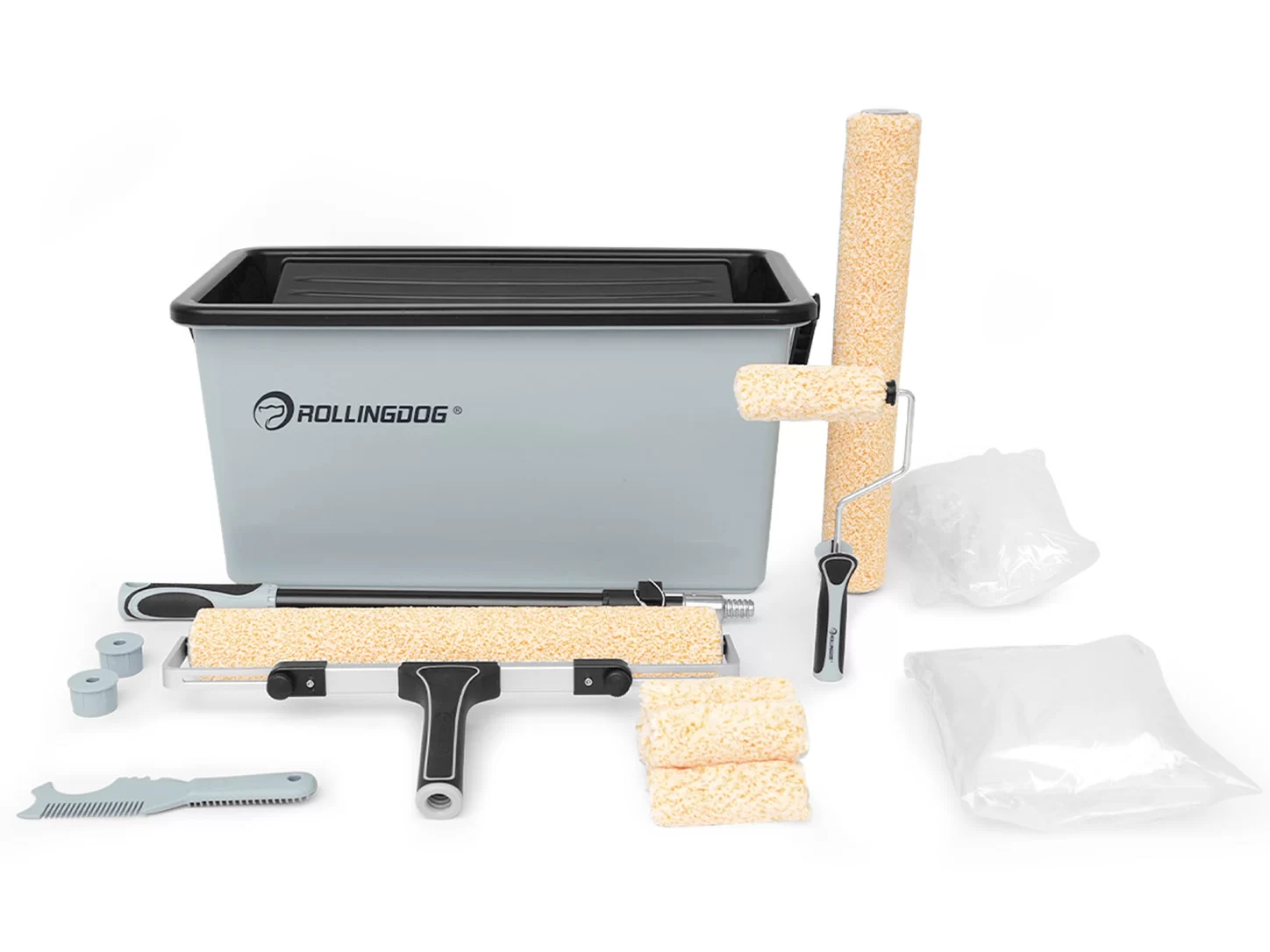
Most residential repaint calls trace back to one cause: wrong roller spec for the surface. Wrong nap on smooth drywall creates stipple texture that appears in every finish coat. Wrong nap on textured walls leaves unpainted voids. Neither is a paint quality failure. Both trace back to a specification decision made before the first stroke.
Nap thickness, cover material, frame construction, and the wall-versus-ceiling difference each get their own section. The distributor stocking section covers which SKUs move fastest in professional accounts — and why the consumable consistently outsells the hardware.
Key Takeaways
Why Does Nap Thickness Determine Finish Quality More Than Any Other Spec?
Nap thickness controls how much paint the cover picks up per dip and how evenly it releases per stroke. Every other variable — material, brand, price — matters less if the nap is wrong for the surface. There are two failure modes, and neither is recoverable without repainting.
Too thick for the surface: Excess nap compresses against a smooth wall face and releases more paint than the surface can absorb cleanly. The result is stipple — a raised dot pattern that hardens and shows through every subsequent coat, including the finish. On smooth primed drywall, a 1/2″ nap where 3/8″ is correct produces this consistently.
Too thin for the surface: Thin nap can’t reach into surface depressions. Paint bridges across texture peaks without filling valleys, leaving unpainted voids that show under raking light — a defect contractors call “holidays.” On orange-peel drywall, a 1/4″ cover produces holidays regardless of technique or paint quality.
The professional nap scale for interior latex work:
| Type de surface | Recommended Nap | Notes |
|---|---|---|
| Ultra-smooth / high-gloss | 3/16″–1/4″ | Thicker nap creates stipple on gloss sheens |
| Smooth new drywall | 1/4″–3/8″ | 3/8″ standard for primed drywall |
| Light texture / standard drywall | 3/8″ | Highest-volume professional nap size |
| Medium texture / orange-peel | 3/8″–1/2″ | |
| Heavy texture / knockdown / stucco | 1/2″–3/4″ | |
| Masonry / brick / concrete block | 3/4″–1-1/4″ |
For most interior residential and commercial repaint work — smooth to light-texture drywall — 3/8″ is the correct nap. This is why 3/8″ covers turn faster than any other nap size in professional distributor accounts.
The complete nap thickness reference guide covers additional surface types including exterior masonry, concrete, and specialty coatings.
Professional interior wall work is dominated by smooth-to-light-texture drywall, where 3/8″ nap is the standard specification for latex application. Mismatched nap — particularly 1/2″ or thicker on smooth surfaces — produces stipple texture that requires mechanical removal or a full repaint to correct. Nap selection is the highest-impact specification decision in roller purchasing.
What Changes When Painting Ceilings Versus Walls?
Ceiling painting is usually treated as a footnote to wall painting, with a generic recommendation to “use a shorter nap.” The actual difference goes further than nap length. Ceiling application has a different primary failure mode than wall application, and the specification follows from that — not from surface similarity.
On walls, the failure mode from wrong nap is a surface quality defect: stipple or voids. On ceilings, the primary failure mode is drip — paint that overloads a thick nap, collects at the fiber tips, and falls during application. A 1/2″ nap on a smooth ceiling doesn’t just risk stipple; it actively drips. That’s a cleanup problem and a potential rework problem on projects where finished surfaces sit below.
One nap size shorter on ceilings than the equivalent wall surface — that’s the practical spec, not a rough guideline.
- Smooth ceiling → 1/4″ (not 3/8″)
- Light-texture ceiling → 3/8″ (not 1/2″)
- Popcorn / heavily textured ceiling → 3/4″–1″ (texture depth forces thicker nap, but load control becomes more important than surface match)
Extension poles for ceiling application should allow horizontal strokes without overhead strain — this affects downward pressure on the cover and changes the drip threshold. A correctly loaded 3/8″ cover on a properly extended pole will apply cleanly; the same cover held at an awkward angle from an undersized pole will not.
The distributor angle: Ceiling covers are often a separate purchase from wall covers on the same project. A contractor buying 9″ × 3/8″ covers for walls may buy 9″ × 1/4″ covers for ceilings the same week. Stocking both nap sizes in the same diameter captures that second transaction.
Polyester, Microfiber, or Blended — Which Cover Material Is Best for Interior Walls?
For waterborne latex — the dominant paint chemistry in professional interior work across US and European markets — microfiber and blended covers outperform pure polyester on three measurable dimensions: paint pick-up speed, coverage consistency, and finish smoothness on flat and eggshell sheens.
That doesn’t make microfiber the right choice for every job. Each material has a technical case:
Polyester is the baseline: compatible with all paint chemistries, including solvent-based alkyd, oil-modified urethane, and epoxy coatings where microfiber fiber construction breaks down from solvent contact. It holds up on rough surfaces where fiber abrasion is a concern. The trade-off is lower paint transfer efficiency on smooth interior walls than microfiber. For exterior work, solvent-based coatings, and rough masonry, polyester is the right call.
Microfiber loads faster and releases more consistently per stroke. Covers maintain output deeper into a working day without reloading as often. On eggshell and satin sheens, the higher fiber density produces less stipple on smooth surfaces — the material difference shows up in finish quality, not just speed. No solvent compatibility; water cleanup only.
Blended covers split the difference. Polyester durability with better pick-up characteristics than pure polyester. When an account mixes latex and occasionally uses solvent-modified products, a blended cover works across more of the range than either single-material option — the most versatile stocking choice for distributors whose account composition is mixed.
Foam doesn’t belong on walls. It traps air during latex application, producing surface bubbles that require sanding to correct. The right context for foam is cabinet doors, trim detail, and furniture refinishing where thin film deposition matters more than coverage rate.
Natural fiber (lambswool and similar) is historically matched to oil-based paint. VOC regulations — EU Directive 2004/42/EC in European markets, parallel EPA and state-level regulation in the US — have pushed professional painting markets toward waterborne latex formulations, which reduces the technical case for natural fiber in mainstream professional work. It remains appropriate where true oil-based alkyd is specified: historic restoration and some industrial coatings work.
| Cover Material | Meilleur pour | Durabilité | Reusability |
|---|---|---|---|
| Polyester | Solvent-based, rough surfaces, exterior | Haut | 1–2 washes |
| Microfibre | Waterborne latex, smooth–medium walls | Modéré | 3–5 washes |
| Blended | Mixed latex/solvent environments | Haut | 2–4 washes |
| Foam | Trim, cabinets, furniture | Faible | Single use |
In professional interior painting, waterborne latex formulations have become the dominant chemistry in both US and EU markets, driven by VOC regulations including EU Directive 2004/42/EC and equivalent North American standards. Microfiber roller covers are the better technical match for waterborne latex: higher fiber density loads and releases paint more efficiently per stroke, reducing dip frequency and covering more area per working hour.
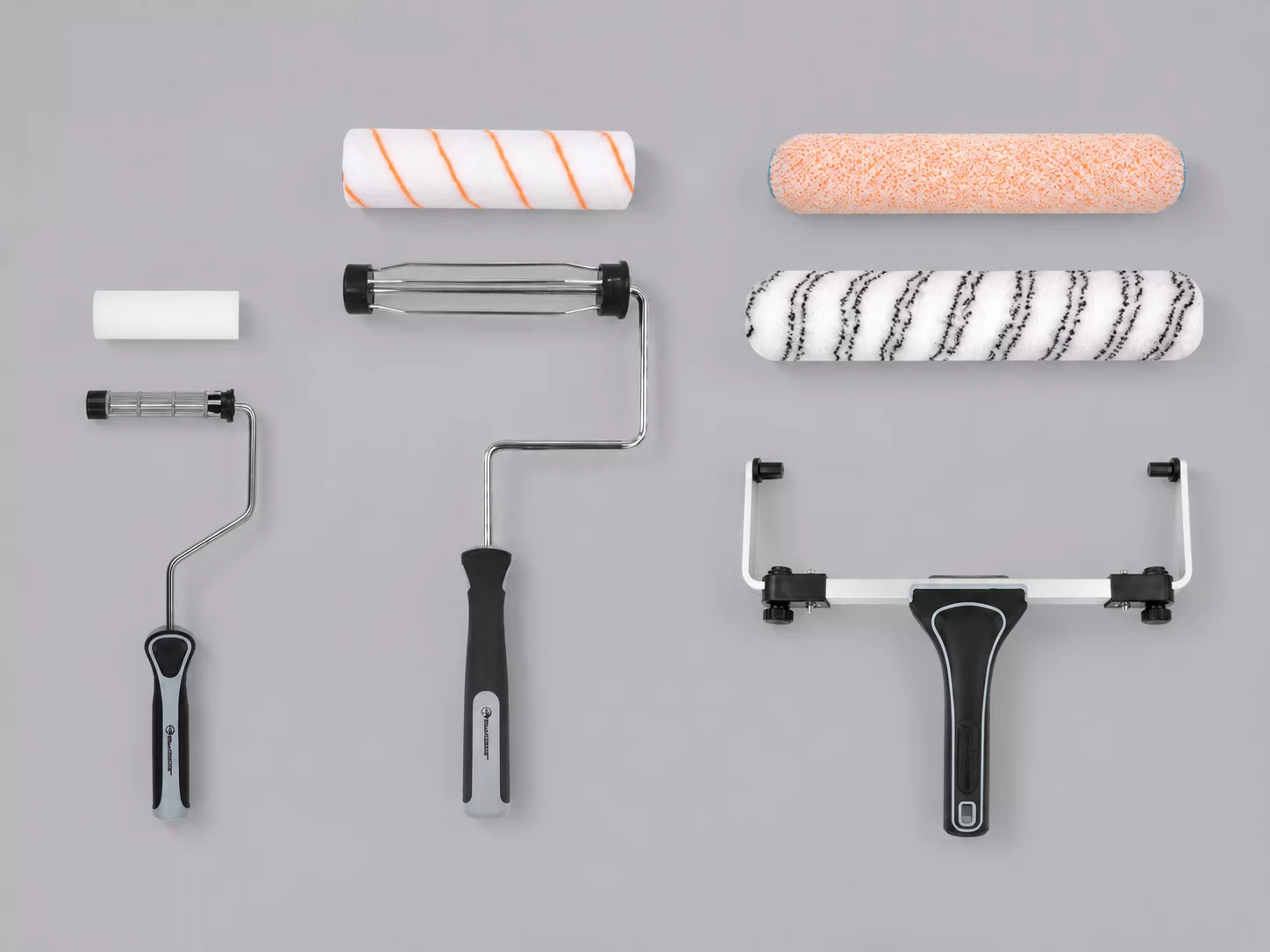
The ROLLINGDOG roller cover range includes polyester, microfiber, and blended options across the professional product line, all produced to ISO 9001 batch specifications.
What Makes a Paint Roller Frame Worth Using Through a Full Commercial Job?
A frame that wobbles under a loaded cover at the start of a ceiling run, or bends under the torque of a 3/4″ nap on heavy stucco, stops the job. Frame quality gets less attention than cover selection. It also fails at the least convenient time.
Size selection follows the application:
- 4″: Trim, door panels, cabinet faces
- 7″: Door faces, recesses, narrow wall sections
- 9″: Standard interior — the highest-volume professional frame size
- 12″–18″: Production environments, large open ceiling and floor areas, commercial repaints
Wire cage construction is where most frame quality differences show up. A 5-wire cage distributes load across the cover core more evenly than a 3-wire design. On high-pile naps (1/2″ and above), a 3-wire frame allows the cover to flex slightly under lateral load, producing uneven pressure and uneven coverage. In production environments — where the same frame runs for hours — 5-wire construction also extends cover life by reducing axial stress on the core.
End-cap compatibility is worth checking before stocking mixed-brand combinations. Threaded end caps in one brand may not accept cover cores from another. Incompatible systems generate returns and contractor complaints that land on the distributor.
Steel is the standard frame material. Fiberglass resists corrosion in humid conditions — exterior work, basement environments, flood remediation — and weighs slightly less over a long working day, which matters more than it might appear.
How to choose a roller frame covers cage construction standards and size selection in more detail.
What Actually Separates Professional-Grade from Retail-Grade Roller Covers?
“Professional” on a roller cover package is not a specification. It’s a price-tier label. The differentiators that determine whether a cover performs under production conditions are fiber density, core material, and end-cap construction — none of which appear on most retail packaging.
Professional-grade covers are manufactured to a minimum fiber count per unit area. Higher density holds more paint per stroke, releases more consistently, and maintains finish quality through a longer working cycle. A retail-grade cover at the same stated nap thickness will have lower density — it loads less and loses consistency faster under repeated use, even though it looks the same on the shelf.
Core material is what determines reusability. Retail-grade covers use cardboard cores: cardboard absorbs water and solvent, expands unevenly, and deforms after the first wash, which is why they’re designed as single-use products. Professional-grade covers use phenolic resin cores that resist absorption, hold their shape through washing, and allow microfiber covers to be cleaned and reused 3–5 times with proper care.
A professional-grade cover that costs $3–5 more per unit and doesn’t shed eliminates customer complaints, returns, and the handling cost that accompanies both. The price difference is absorbed in the first avoided return.
ROLLINGDOG roller covers are produced under ISO 9001 quality management, BSCI social compliance, and FSC and GRS sustainable materials certification. All products undergo batch-level fiber density verification before shipment.
The distinction between professional-grade and retail-grade roller covers is not brand but construction. Phenolic resin cores resist water absorption and allow covers to be washed and reused 3–5 times; cardboard cores deform after the first wash and are designed for single use. Fiber density — verified per production batch under ISO 9001 standards — determines whether a cover maintains consistent paint release across a full working day or sheds fibers into the finish coat.
What Should Distributors Actually Stock?
A productive roller cover assortment for professional markets covers three nap sizes and two materials. Four SKUs handle the majority of professional job requests without overstocking:
| Cover Size | Nap | Matériau | Primary Application |
|---|---|---|---|
| 9″ | 3/8″ | Microfibre | Smooth–medium interior walls — highest reorder velocity |
| 9″ | 1/2″ | Polyester blend | Medium–heavy texture, exterior surfaces |
| 9″ | 3/4″ | Polyester | Heavy texture, stucco, masonry |
| 4″ | 3/8″ | Microfibre | Trim, doors, detail work |
Add a 9″ × 1/4″ microfiber as a ceiling-specific SKU when the distributor’s account base includes professional contractors doing volume interior work. Most distributors don’t stock it. Most professional painters working full interiors need it.
Frames follow a simpler logic: 9″ steel 5-wire cage covers the majority of professional work. Add 4″ for trim accounts and 18″ for contractors doing large commercial ceiling volume.
For OEM and private label roller covers, ROLLINGDOG’s ODM programme covers minimum order quantities and custom specification options. Specification sheets for all cover materials and nap sizes are included in the ROLLINGDOG product catalogue — available as a free download.
Why Is My Roller Leaving Lines, Drips, or Fiber on the Wall?
Most roller application problems trace back to a spec mismatch, not a product defect. Identifying the actual root cause determines whether the fix is a different SKU or a different technique.
| Problem | Root Cause | Specification Fix |
|---|---|---|
| Stipple / dot texture on smooth wall | Nap too thick for surface | Switch to 3/8″ or 1/4″ |
| Voids / holidays on textured wall | Nap too thin to fill surface depressions | Use 1/2″–3/4″ |
| Drip marks on ceiling | Nap too thick; overloads under gravity | Use 1/4″–3/8″ ceiling cover |
| Fiber shedding mid-job | Low-density retail cover with cardboard core degrading | Switch to phenolic-core professional cover |
| Lap marks / visible stroke lines | Wet-edge technique failure or incorrect paint viscosity | Not a roller spec issue — adjust technique and check dilution ratio |
The last row is included deliberately. Lap marks are the most common application failure attributed to the roller when the roller isn’t the problem. A professional-grade cover at the correct nap won’t eliminate lap marks if the wet edge isn’t maintained — and recommending a better cover to a painter with a technique issue doesn’t help them.
For further detail on diagnosing finish defects, fixing paint streaks and roller marks on walls covers the full range of application failures and their causes.
Questions fréquemment posées
What nap thickness is best for interior walls?
For smooth to light-texture interior walls — the most common surface in residential and commercial repaint work — 3/8″ is the professional standard with waterborne latex paint. Use 1/4″ for high-gloss finishes on very smooth surfaces. Medium texture (orange-peel) calls for 3/8″–1/2″; heavy texture and stucco require 1/2″–3/4″. The 3/8″ nap size accounts for the majority of professional cover reorders across most distributor accounts.
What is the difference between microfiber and polyester roller covers?
Microfiber covers have higher fiber density than polyester, which means faster paint loading and more consistent release per stroke on smooth surfaces with latex paint. Polyester covers are more durable and compatible with solvent-based formulations including alkyd and epoxy coatings. For professional interior latex work, microfiber or blended covers outperform polyester on finish quality. For solvent-based coatings and rough exterior surfaces, polyester is the correct choice.
What roller do professional painters use for interior walls?
Most professional interior painters use a 9″ frame with a 3/8″ microfiber or blended cover for standard interior walls. Ceiling work uses the same frame with a shorter nap — typically 1/4″–3/8″ depending on ceiling texture — to prevent drip. Frame quality matters in production environments: a 5-wire steel cage with a phenolic-core cover handles a full commercial working day; a retail-grade 3-wire frame with a cardboard-core cover does not.
Can roller covers be reused, and how many times?
Phenolic resin core covers — professional grade — can be washed and reused 3–5 times with thorough cleaning immediately after use. Cardboard core covers absorb water during washing, expand unevenly, and deform on the core — they are designed for single use. The core material, not the cover type or brand, is the determining factor in reusability.
How many roller covers should a distributor stock per roller frame?
In professional painting accounts, cover reorder velocity runs 3–5× higher than frame replacement. A contractor who replaces frames twice a season may work through 15–25 covers in the same period. Per 10 frames stocked, a well-supplied professional distributor typically moves 30–50 covers in an active work season. The 9″ × 3/8″ microfiber is the highest-velocity SKU across most professional markets.
Get the nap right for the surface first — it’s the highest-impact decision and the one least likely to be fixed after a defect appears. Match material to paint chemistry: microfiber or blended for waterborne latex, polyester where solvent-based products appear. Frame construction matters more in production environments than in single-room residential work. On ceilings, drop one nap size to avoid drip — a failure mode that doesn’t occur on vertical surfaces.
For distributors, the stocking arithmetic follows from those decisions: three nap sizes (3/8″, 1/2″, 3/4″) in two materials cover most professional job requests without overstocking. Covers turn 3–5× faster than frames in active accounts — the consumable is where reorder volume lives.
Full specification sheets for roller covers, frames, and extension poles are available in the ROLLINGDOG product catalogue. For OEM and private label enquiries, contact the ROLLINGDOG team.
Sources: EU Directive 2004/42/EC on the limitation of emissions of volatile organic compounds (VOC); ROLLINGDOG internal manufacturing and distributor account data, 2026.

Written by the ROLLINGDOG product and application team — professional painting tools engineers and field trainers with combined experience across residential, commercial, and industrial coating projects.